
How to Structure Your Meta Ads Payments So Campaigns Never Get Interrupted — and Can Scale Consistently
If your Meta ads keep turning off, slowing down, or randomly losing performance, there’s a good chance the issue isn’t your targeting, your creative, or your offer.
It’s your payment structure.
This is one of the most overlooked reasons campaigns fail to scale. Not because the ads aren’t working, but because they’re not being allowed to run consistently enough to build momentum.
Scaling requires stability. And stability starts with how your ad spend is funded.
Why This Happens (And Why It Feels So Frustrating)
If you’re dealing with this, it’s usually not because you don’t understand how ads work.
It’s because cash flow feels tight.
You’re likely running ads on a credit card. The balance climbs, it gets close to the limit, you make a payment, it clears, and then the cycle repeats. Every time you pay it down, it feels like money leaving your account, not money being reinvested.
So even if your ads are working, it doesn’t feel like they are.
You feel the outflow more than the return. And because of that, funding the account becomes reactive instead of planned. Payments happen when they have to, not as part of a system.
That’s where instability starts.
The Real Issue Isn’t Budget — It’s Lack of Structure
Most people assume the solution is:
I need more cash
I should just pay the card off
I need a bigger budget
That’s not actually the core problem.
The real issue is that there’s no predictable funding cadence tied to spend. Without that, every payment feels like a hit instead of part of a controlled system that supports revenue generation.
The Hidden Cost of Campaign Interruptions
When your account hits a payment issue and ads stop running, it’s not just an inconvenience.
It directly impacts performance.
Campaigns can re-enter or destabilize the learning phase
Delivery consistency breaks, which affects optimization
Momentum is lost in the auction
You miss conversions that would have happened if ads kept running
Even short pauses can create ripple effects.
And when this happens repeatedly, scaling becomes extremely difficult. You’re not building performance. You’re constantly restarting it.
The Shift: Treat Ad Spend Like a Weekly Operating Expense
Instead of thinking about ads as something you “pay off,” you need to treat them like a planned, recurring operating cost tied directly to revenue generation.
What This Looks Like in Practice
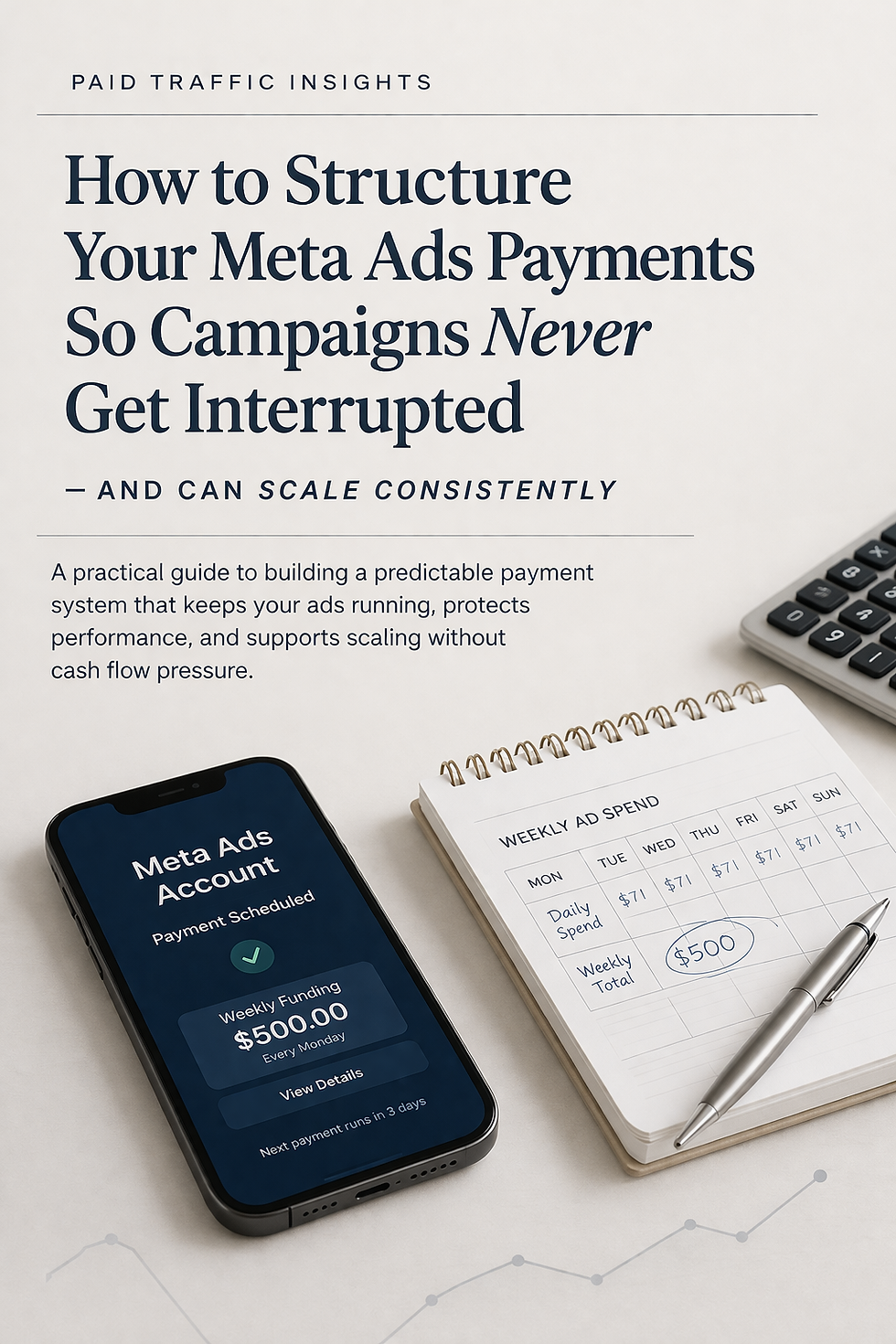
Look at your current daily ad spend
Project what that equals over the next 7 days
Fund the account on that cadence before it becomes urgent
This can be weekly, biweekly, or aligned to your billing cycle. The key is consistency.
Once this is in place, you’re no longer reacting to a maxed-out card. You’re operating on a schedule.
How This Enables Scaling (Not Just Stability)
Most people don’t realize that this is actually a scaling system.
As you increase budgets, your spend rises. That means your funding needs to rise with it.
Without structure:
You hit limits faster
Payments become more stressful
Campaigns become more fragile
With structure:
You project spend in advance
You adjust funding before issues occur
You maintain uninterrupted delivery as you scale
The Key Principle
As spend increases, your funding cadence becomes more important, not less.
This is what allows you to scale without constantly hitting walls.
Why This Actually Improves Cash Flow (Not Hurts It)
This is where most people get stuck mentally.
If your ads are working, they are generating revenue.
That means:
The money to fund the ads is being created by the ads
The issue is timing and visibility, not absence of money
When you don’t structure funding, you disconnect the spend from the return. You feel the cost, but you’re not clearly tracking the income it’s producing.
Once you move to a consistent cadence:
Spend becomes predictable
Funding becomes planned
Performance becomes easier to evaluate
And most importantly, you stop making decisions based on pressure.
A Simple Weekly Check System
This does not need to be complicated.
Once per week, or every few days if you are actively scaling:
Check your current daily ad spend
Project your next 7 days of spend
Confirm available credit or balance
Add funds proactively if needed
Adjust projections if budgets are increasing
This takes a few minutes, but it removes one of the biggest sources of instability in your campaigns.
A Necessary Reality Check
If you truly don’t have the money to fund ads consistently, there are only two real scenarios:
You are in a short-term investment phase and expect returns later
Your ads are not performing well enough to sustain themselves
Both are valid, but they require different decisions.
If you’re investing ahead of return, you need to plan for that intentionally.
If performance is the issue, the solution is not to randomly throttle funding. The solution is to fix the system.
The Outcome
When you move from reactive payments to structured funding:
Campaigns stop turning on and off unpredictably
Performance stabilizes
Scaling becomes controlled and intentional
You avoid unnecessary learning resets and lost conversions
Most importantly, you stop feeling like ads are draining your cash flow.
Instead, you start seeing them for what they actually are:
A controlled input into a revenue system that you can scale with confidence.