
Why Getting a Professional Business Video Doesn't Require a Full Production Day
- May 2
- 5 min read
Updated: May 4
Most small business owners have a version of the same story. They decide they need a video — for their website, for social, for a product launch — look into what it would cost, and quietly put it back on the shelf. The number feels too high. The process feels too complicated. The whole thing gets filed under "eventually."
What usually stops them isn't lack of interest. It's a mental picture of what video production requires — a crew, a full day on location, multiple setups, a project that takes weeks to get off the ground. That picture exists because it's accurate for a certain kind of work. But it's not the only kind of work that exists.
Most small businesses don't need a full production day. They need one of two simpler things. Understanding the difference between them is what makes video accessible.
What Full Production Actually Is — and When You Actually Need It
A full production day involves a crew, professional lighting, multiple camera setups, location logistics, and often casting or talent. It's designed for campaigns that require a specific scale of execution — a national TV commercial, a multi-location brand film, a content system built to generate dozens of assets at once. The investment is real and it's justified when the scope calls for it.
For most small businesses, the scope doesn't call for it. What they need is either a professional finish on footage they already have, or a focused shoot to capture something specific. Those are two different problems with two much more accessible solutions.
Path 1: You Already Have Footage — You Just Need It Finished
This is more common than most people realize. An event that got recorded. A product shoot from last year. Behind-the-scenes content from a phone. A founder video someone shot in the office. Raw material that exists but has never been turned into anything usable.
Here's the thing most small business owners don't know: the quality of a finished video has much more to do with what happens in post-production than what it was shot on. Color grading, sound design, music, pacing, and how the edit structures the story — these are what separate a professional-looking video from raw footage. A skilled editor working with decent phone footage can produce something that looks far more professional than most people would expect. The camera matters less than the craft applied to what it captured.
This matters because it means footage most business owners have written off as unusable is often the starting point for something genuinely good. Research from Wistia, analyzing over 100 million videos, found that production budget has no meaningful correlation with engagement — audiences watch and respond to content that feels valuable and authentic, regardless of how it was shot.
What professional post-production does with that footage: editing the best material into a coherent story, correcting and grading the color, adding music and sound design, incorporating voiceover or motion graphics where the project calls for it. The result is a finished video — not raw files to sort through, but something deployable.
Edit-only projects like this start at around $1,500 for straightforward finishing work, and scale up to $3,500 for a fully built piece with scripting, voiceover, and motion graphics.
Path 2: You Need Footage Captured — But Not a Full Production Day
Sometimes the footage doesn't exist yet. A founder interview that was never recorded. B-roll of the product, the space, or the team. Something specific that needs to be captured before an edit can begin.
This is where the assumption that video requires a full production day does the most damage. It leads business owners to believe their only options are DIY or a $10,000 crew day — and when neither option fits, nothing happens.
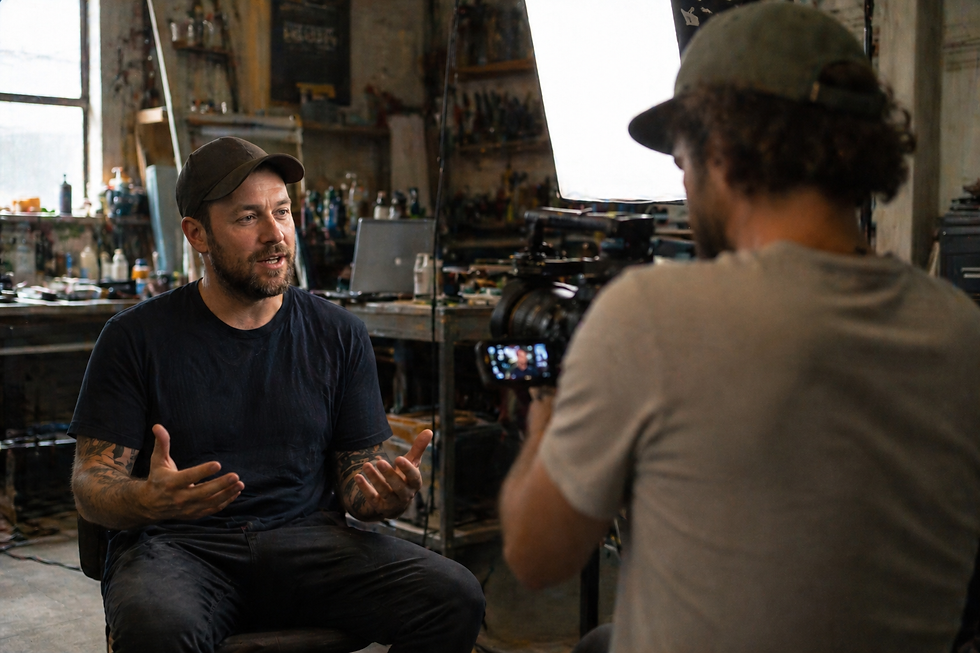
The reality is that a focused, limited-scope shoot exists specifically for this situation. A professional cinematographer showing up for a half day to capture B-roll. A two-person crew — a cinematographer and a producer — conducting and capturing a founder interview in a few hours. No casting. No lighting rigs. No all-day logistics. Just the right person with the right gear capturing one clear thing, paired with a professional edit to turn it into a finished video.
Short-form video drives more reach and engagement than any other content format on social right now — Instagram Reels alone generate 122% more reach than single images, according to Buffer's 2025 analysis of over 4 million posts. But the format advantage only matters if the content exists. A focused shoot is the most direct path to getting it made.
Shoot-and-edit projects like this start at around $4,000 for a half-day B-roll shoot, and $5,500 for a half-day interview shoot — both including professional post-production finishing.
How to Know Which Path You're On
Ask yourself three questions.
Do you have existing footage? If yes — event coverage, product shots, behind-the-scenes content, recorded interviews — you're likely on Path 1. The question becomes whether what you have is workable, which a quick conversation with a post-production professional can answer.
Do you need someone or something specific on camera that hasn't been captured yet? If yes — a founder story, a product demo, location footage — you're on Path 2. The question becomes how focused the shoot needs to be, which determines the scope and cost.
Do you know what the finished video needs to accomplish and where it will live? This question matters for both paths. A video built for your homepage performs differently than one designed for a paid social ad. Knowing the destination before production starts shapes every decision that follows.
What to Look for When Hiring for This Kind of Work
At this scope and price point, the right production partner operates differently than a full-service agency. You should expect clear pricing upfront — not a range, an actual number based on a defined scope. You should expect fast turnaround, typically one to two weeks from start to delivery for straightforward projects. You should expect work samples that show the range from simple finishing to more built-out pieces, so you can see what your starting point is likely to produce.
What you shouldn't need is a lengthy discovery process before anyone will give you a number. These are defined, accessible engagements. The process should feel proportional to the investment.
Most small businesses have been operating without professional video not because they don't see the value, but because the version they were aware of didn't fit. Both paths described here exist, they're accessible, and the process is simpler than most people assume.
If you're not sure which path fits your situation — or whether what you have is workable — that's a short conversation. We scope projects quickly and honestly, and if it's not the right fit, we'll say so.
If you already have footage that needs finishing, you can learn more about how we handle that here. If you need footage captured and a finished video delivered, that process is covered here. Or if you'd rather just talk it through, you can schedule a call below.